 |
Canis lupus
Lobo (Sp), Wolf (G), Loup (F). Also called wolf, common wolf, timber wolf, or tundra wolf. We use the name gray wolf (instead of just "wolf") in order to differentiate this animal from the red wolf of North America, which is a different species, and the maned wolf of South America and the extinct Falkland Island wolf, which are not actually wolves.
DESCRIPTION (male) Head and body length 40-60 inches (100-150 cm). Tail length 14-22 inches (35-56 cm). Shoulder height 26-32 inches (66-81 cm). Weight 80-120 pounds (35-55 kg), occasionally much more. Females are about 20 percent smaller. Chromosome count is 78.
The gray wolf is the largest wild member of the dog family and is considered by scientists to be the ancestor of the domestic dog. (It has been generally accepted that the domestic dog was tamed about 14,000 years ago; however, a recent study indicates that it may have been as long as 135,000 years ago.) The gray wolf resembles a large German shepherd dog (only much larger) with its heavy frame, long legs, large feet and thick, bushy tail. The skull is especially large, with powerful jaws and large, well-developed meat-eating teeth. The fur is moderately long and thick, being almost luxurious. Coat color ranges from nearly white through shades of gray and brown to black, with the grays most common. Color phases are not geographically separable, and variations are often found in the same pack; however, lighter colors (and larger wolves) predominate in northern areas.
BEHAVIOR An intelligent, social animal, living in family groups or packs that sometimes include more than one family, or other individuals besides the family. There is a dominant pair, with the male the pack leader. Pack members hunt together, cooperating to run down and kill prey animals that are typically larger than themselves. Principal prey includes deer, elk, moose, caribou, mountain sheep, bison and muskox, domestic sheep and cattle, and also beaver, rabbit and various rodents. The size of a wolf pack often relates to the size of prey animals in the area, as more wolves are required to bring down larger animals. Packs are territorial, with their boundaries marked and defended against other packs. Size of home range depends on the amount of prey available. Packs that depend on migrating caribou will migrate along with them. A wolf can run 25 mph (40 km/h) for a mile or two, but can lope 10-12 mph (16-19 km/h) more or less indefinitely when chasing prey. Swims well. Eyesight is excellent, hearing good, sense of smell superb. Has several vocalizations, each with a particular significance. Mating season is late winter or early spring, with the pups (range is 1-11, but usually six) born two months later in an underground den. Wolves mate for life. Life expectancy is 10-16 years in the wild, up to 20 years in captivity.
HABITAT Forest, tundra, plains and mountains.
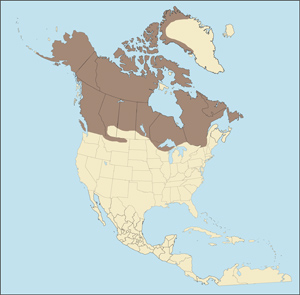
DISTRIBUTION Originally all of Alaska and Canada, including most of the arctic islands; parts of Greenland and Newfoundland; most of the United States; and the interior plateau in Mexico. At present, its distribution is mainly from the Canadian border northward; however, there are isolated populations in the states of Washington, Montana, Minnesota, Wisconsin and Michigan, and possibly also in a small area in northern Mexico.
Besides North America, the gray wolf is also found in Europe and Asia.
REMARKS Hunting the intelligent, wary wolf is difficult, and most are taken by chance encounter, though a person spending enough days in good wolf country will see wolves eventually and may get a shot. On a wilderness hunt for other species, it sometimes is productive to sit in a blind within rifle range of a fresh gut pile.
TAXONOMIC NOTES Some 24 subspecies of gray wolf are listed in North America, but differences are minor. All unendangered forms are combined here for record-keeping purposes.
STATUS The United States Fish and Wildlife Service (USFWS) lists as endangered the gray wolf from the eastern United States (1967), northern Rocky Mountains (1973), Mexico (1976), Texas (1976), and the rest of the conterminous United States, except Minnesota (1978). Limited hunting is now legal in Wisconsin, Michigan, Idaho, Montana, and Wyoming.
Wolf numbers are estimated at 4,000-7,000 in Alaska and at more than 30,000 in Canada; overall populations do not appear to have declined since the 1950s. There are about 1,200 in Minnesota, Wisconsin, Michigan, and Montana. As of 2011 report there is an increasing number of packs in Idaho and they have huntable population. There are regular reports of wolves from the northwestern conterminous U.S. (Nowak, 1991).
|



 LOGIN
LOGIN


