 |
 |
Hippotragus niger roosevelti
Sable de Roosevelt (Sp). Named after explorer and hunter Kermit Roosevelt, son of former U.S. President Theodore Roosevelt. Sometimes called East African sable, which is inappropriate, because the common sable has an equally extensive distribution in East Africa. Formerly called Shimba sable, for the Shimba Hills in Kenya, where it was first described for science by Edmund Heller on the Roosevelts' 1909-1910 East African safari, but this name is no longer suitable (please see text below).
DESCRIPTION Slightly smaller, lighter in color and with shorter horns than the common sable. Males vary from seal brown in the Shimba Hills to reddish black in the Selous and Kilombero. Females are a bright rufous.
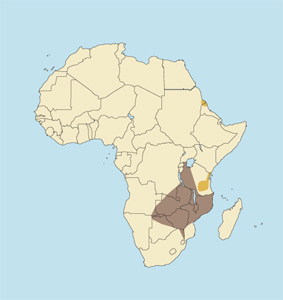
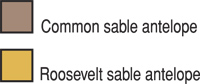
DISTRIBUTION From the Shimba Hills near the southeastern coast of Kenya, southward discontinuously in coastal Tanzania east of longitude 38°E to the Selous Reserve in southern Tanzania; throughout the Selous Reserve; in the Kilombero Valley to the west of the Selous; and south and southeast of the Selous; and south towards the Ruvuma River along the Tanzania - Mozambique border and a select part of Northern Mozambique in the Niasse Reserve, though sable specie below the Ruvuma River have shown evidence of hybridization and will be considered common sable without supporting genetic evidence.
STATUS The Shimba Hills population of about 120 animals is legally protected. So are the small, scattered populations along the Tanzania coast, though they suffer from local poaching. But a 1998 aerial survey counted 3,900 sable in the Selous and another 6,700 outside it, particularly to the southeast, so roosevelti can no longer be considered endangered.
TAXONOMIC NOTES In previous editions, we followed prevailing scientific opinion in limiting roosevelti to the small, endangered Shimba Hills population, which we called the Shimba sable. Although Roosevelt and Heller believed the subspecies extended from the Shimba Hills southward along the coast to the Kigani River opposite Zanzibar Island, later authorities limited it to the Shimba Hills. Recent DNA testing has not only shown that Roosevelt and Heller were correct, but also that roosevelti is found throughout the Selous Reserve and in adjoining areas to the west and south. What remains to be done is to establish its western and southern boundaries through ongoing DNA testing.
REMARKS The Roosevelt Sable is found in Tanzania and its distribution is primarily north of the Ruvuma River. DNA studies have concluded that the Sable in Tanzania are pure roosevelti and additional studies have shown that there are pure roosevelti in Northern Mozambique on the Niassa Reserve. DNA testing has also shown that common sable are present in the Niassa Reserve as well as hybrid sable with both common (H. n. nigra) and Roosevelt (H.n. roosevelti) DNA. Without a specific identifiable trait to determine the difference between a Roosevelt Sable and Common Sable with a photograph, SCI will require a DNA test be completed for Roosevelt Sable taken south of the Ruvuma River. Without DNA verification, all sable taken in Mozambique will be entered into the record book as the larger of the two species which is Common Sable.
Hunting of roosevelti will probably be limited to the Selous Reserve until the western and southern distribution limits are determined. The sable of the Selous have been hunted under a quota of about 70-80 a year, and this is expected to continue. All sable already in the Record Book from the Selous have been reclassified as Roosevelt sable. All new sable entries from the Selous will be recorded as Roosevelt sable.
|



 LOGIN
LOGIN


